“My mentor offered me two days of remote work a week. I said yes straight away… and since then, I've spent my days alone in front of my screen, not daring to bother anyone.” This account sums up the paradox of remote work on a work-study contract: real comfort, and a real risk for a young person in training.
In short: no legal text prohibits remote work for an apprentice or for a work-study student on a professionalisation contract: as a fully fledged employee, they are subject to the company's rules (collective agreement, charter or, failing that, an agreement with the employer, article L1222-9 of the French Labour Code). Remote work is voluntary on both sides: neither the company nor the work-study student can impose it, but a refusal must be justified if an agreement or a charter makes the position eligible. In practice, one day a week is the right setting, because the apprenticeship supervisor (maître d'apprentissage) must be able to carry out their role. The employer provides the equipment; the flat-rate allowance is exempt up to €2.70 per day (€59.40 per month) in 2026. An accident at home during working hours is presumed to be a workplace accident, and CFA days are never remote work.
Does an apprentice have the right to work remotely?
Yes. The apprenticeship contract is an employment contract, and article L6222-23 of the Labour Code provides that apprentices benefit from the provisions applicable to all employees, insofar as they are not incompatible with their situation as young people in training. Remote work, defined by article L1222-9, excludes no type of contract. The same logic applies to the professionalisation contract, a standard fixed-term or permanent contract.
What the law says precisely:
- remote work is voluntary: the employer cannot impose it on you, except in exceptional circumstances such as an epidemic (article L1222-11), and your refusal is not grounds for terminating the contract;
- it is not an enforceable right: you cannot demand it;
- if an agreement or a charter makes your position eligible, a refusal by the employer must be justified;
- remote workers have the same rights as employees working on the premises.
Remote work is not an enforceable right: it is a working arrangement that is negotiated. But it cannot be refused to you solely on the grounds that you are an apprentice.
How is remote work set up in the company?
Three routes coexist, and knowing which one applies where you work changes how you should word your request.
| Framework | Who decides | What it means for the work-study student |
|---|---|---|
| Collective agreement (company or industry) | Employer and unions | The most protective: days, eligibility and allowance are set out in writing. Check whether work-study students are included. |
| Charter | Employer, after consulting the CSE (staff representative body) | Rules set by the employer; a refusal must be justified. |
| Individual agreement | You and your manager | The most flexible and the most fragile: put it in writing (an email is enough). |
Since the 2017 ordinances, no amendment to the contract is required, and remote work does not appear on the apprenticeship contract's Cerfa form: it is negotiated separately. First reflex at the start of the year: ask HR for the agreement or the charter, and look at three points — length-of-service requirements (often 3 to 6 months), whether work-study contracts are mentioned, and the number of days allowed.
How many days of remote work should you ask for?
The law sets no cap, but work-study programmes impose their own arithmetic: your week at the company is already split up.
| Work-study rhythm | Days at the company per week | Recommended remote work |
|---|---|---|
| 2 days company / 3 days CFA | 2 | 0, exceptionally 1 |
| 3 days company / 2 days CFA | 3 | 1 maximum |
| 1 week / 1 week | 5 (company week) | 1 to 2 |
| 3 weeks / 1 week | 5 (company weeks) | 1 to 2 |
Why do so many companies limit remote work for work-study students? Not just out of mistrust: an apprenticeship is a training contract, and the apprenticeship supervisor's role is to help you acquire your skills (article L6223-5). Feedback from the field is consistent: working mostly remotely isolates you, makes your assignments poorer and slows down your integration, whereas one day a week eases fatigue and the transport budget. Three simple rules:
- no remote work in the first few weeks, until you know who to turn to with your questions;
- never on a day when your apprenticeship supervisor is away;
- never the day after a CFA week, when you need to pick up the thread.
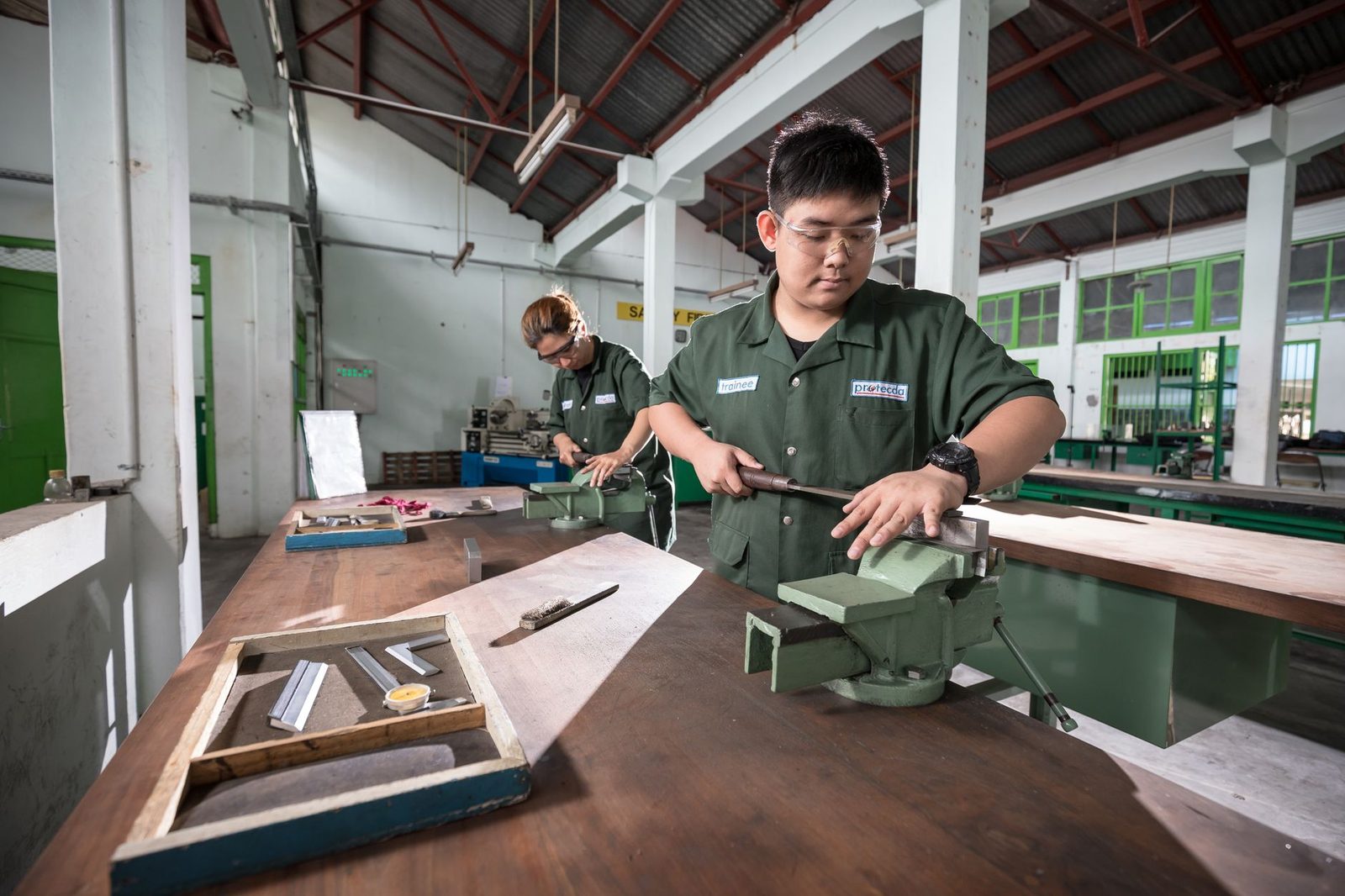
Finally, remote work presupposes work that “could also have been carried out on the premises”: in a workshop, on a building site, in a kitchen or at a reception desk, it is physically impossible.
Are CFA days remote work?
No. Training time at the CFA is included in working hours and paid (article L6222-24), but it is neither remote work nor leave, even when classes are followed remotely. Distance learning falls under the rules of vocational training and of the CFA, not under the company's remote work agreement: we cover it in detail in our article on distance learning work-study programmes.
Can an apprentice who is a minor work remotely?
Nothing prohibits it, but caution is called for. Under-18s cannot work more than 8 hours a day or 35 hours a week (article L3162-1), and are entitled to a 30-minute break after 4.5 hours of work (article L3162-3). These limits are hard to monitor at home, and close supervision of a minor is difficult to provide remotely. If the company offers it, ask for it to be occasional, with a check-in scheduled during the day.
What must your employer provide and pay for?
Equipment
Professional expenses are borne by the employer: the national interprofessional agreement (ANI) of 26 November 2020 reiterates that the employer provides the equipment needed for remote work (computer, software, secure access, phone if the position requires one). Furniture, on the other hand, is often at your own expense: ask what is available in stock (monitors, headsets), and consider an adjustable laptop stand with an external keyboard, which fixes most of the poor postures flagged by the INRS (French occupational health and safety institute).
The remote work allowance
The flat-rate allowance is only compulsory if an agreement or the charter provides for it; it then applies to work-study students as to other employees. In 2026, URSSAF exempts it from social contributions within the following limits:
| Calculation method | Without a collective agreement | With a collective agreement |
|---|---|---|
| Per day of remote work | €2.70, up to €59.40/month | €3.30, up to €72.60/month |
| Monthly flat rate, 1 day a week | €11 | €13.20 |
| Monthly flat rate, 2 days a week | €22 | €26.40 |
Meal vouchers
Since remote workers have the same rights as their on-site colleagues, if the company hands out meal vouchers (titres-restaurant), you are entitled to them on your remote working days under the same conditions. Over a year, this adds up to hundreds of euros. We cover these reimbursements in detail in our article on work-study students' professional expenses.
An accident while working remotely: are you covered?
Yes. Article L1222-9 sets out a clear presumption: an accident occurring at the remote work location during professional activity is presumed to be a workplace accident. Inform your employer within 24 hours; they then report it to the Assurance Maladie (French health insurance), just as for an accident on site (see our article on workplace accidents in work-study programmes). Two precautions: have your remote working hours recorded in writing, and inform your home insurer, which generally covers remote work at no extra premium.
How do you keep real mentoring at a distance?
The number one risk is not productivity, it is invisibility: an apprentice nobody hears from is an apprentice people forget to train.
- Lock in a weekly check-in with your apprenticeship supervisor: 30 minutes, same day, even if there is “nothing to say”.
- Write down what you do: three lines at the end of the day (done, blocked, planned). It is also a goldmine for your logbook and your dissertation.
- Dare to interrupt: stuck on a problem for 20 minutes, you ask someone.
- Keep on-site days for learning tasks (observation, questions, meetings) and save writing or industry monitoring for home.
If your mentor becomes unreachable, alert your CFA contact, then, if necessary, the apprenticeship mediator at the chamber of commerce or trade. To go further, read our article on the role of the apprenticeship supervisor.
How do you negotiate remote work, and what should you put in writing?
Avoid raising the subject at the first interview if the job ad does not mention it: wait until conditions are discussed or, better still, until the third month, once your first deliverables have been approved. The request that works combines a work-related justification (“writing would benefit from better concentration”), a structured proposal (“on Thursdays, a day without meetings”) and a reversibility clause (“let's review it in six weeks”).
Even with an individual agreement, get the following confirmed in writing:
- the remote working days, fixed or flexible;
- your availability hours and your right to disconnect;
- the declared location and the equipment provided;
- how your apprenticeship supervisor will monitor your progress;
- reversibility for both parties.
If you are still looking for a company, the words “remote work possible” appear more and more often in work-study offers. To estimate your pay, use our pay calculator, and for help with transport and housing, see the financial aid page. Remember the rule that sums it all up: on a work-study programme, you are there to learn first and produce second.