"Too old for an apprenticeship." Candidates aged 30, 35 or 45 who are recognised as disabled workers still hear this, sometimes even from training centres. It is wrong, and this confusion costs perfectly eligible people their contracts every year.
In short: with RQTH status (recognition as a disabled worker), an apprenticeship has no age limit (article L. 6222-2 of the French Labour Code). The contract can last up to 4 years, with pay increased by 15 points during the extra year, and working hours can be adjusted. Every CFA must have a disability officer. The employer receives up to €6,000 from the State for the first year, whatever its size and the qualification, plus €500 to €3,000 from Agefiph in the private sector; in the public sector, FIPHFP funds 80% of the pay. RQTH status is applied for at the MDPH (reply within 4 months), and you are never obliged to disclose your disability.
What does RQTH status change in an apprenticeship contract?
It removes the three barriers that block the most applications: age, pace and the cost of adaptation. The apprenticeship remains a standard employment contract, but several rules are adapted by the Labour Code.
| Rule | Standard rules | With RQTH status |
|---|---|---|
| Maximum age at signing | 29 years of age (with exceptions) | No limit (L. 6222-2) |
| Maximum contract length | 3 years | 4 years (R. 6222-46) |
| Training at the CFA | Normal length of the course | Spread over the normal length + 1 year maximum (R. 6222-47) |
| Pay during the extension | Usual scale | + 15 points of SMIC (R. 6222-48) |
| Working hours | Hours of the role | Adjustment proposed by the occupational physician (R. 6222-49-1) |
| Organisation of training | Classes at the CFA | Teaching adjustments, distance learning possible (R. 6222-50) |
| State grant to the employer (1st year) | €750 to €5,000 depending on size and qualification | €6,000 maximum |
"The length of the apprenticeship contract of a disabled worker may be extended to four years." — article R. 6222-46 of the French Labour Code
These provisions also apply when RQTH status is obtained during the contract (article R. 6222-49): it is never too late to assert your rights.
No age limit: what does it mean in practice?
A 34-year-old changing career, or a 50-year-old who wants a new trade, can sign an apprenticeship contract if recognised as a disabled worker. From age 26, the minimum wage is 100% of the SMIC, i.e. €1,867.02 gross per month since 1 June 2026 (or the collective agreement minimum if higher). The other exceptions to the age limit (top-level athletes, business creation projects, second contracts…) are covered in our article on apprenticeships after 30.
How do the 4-year extension and the pay increase work?
Where the apprentice's condition requires it, CFA teaching is spread over the normal length of the training plus one year at most (article R. 6222-47). The contract is extended accordingly, up to 4 years.
During this extra year, article R. 6222-48 provides for a uniform increase of 15 points applied to the SMIC percentage of the final year of the contract. Example: an apprentice aged 21 to 25 paid 78% of the SMIC in year 3 (€1,456.27 gross) moves to 93% during the extension year, i.e. €1,736.33 gross per month based on the SMIC in force since 1 June 2026. To estimate your own pay, use the pay calculator.
Three useful points:
- The extension is not automatic. It must be justified by the disability, prepared with the CFA's disability officer and the employer, and written into the contract or an amendment.
- Working hours can be adjusted. The occupational physician can propose an adjustment of working time (article R. 6222-49-1), and article L. 6222-37 allows working hours in the company to be adapted: a part-time apprenticeship is therefore possible.
- Training adapts too. Adapted timetable, reinforced support, specific equipment, distance learning if you cannot attend the CFA (article R. 6222-50).
How do you obtain or renew RQTH status?
RQTH status is applied for at the Maison départementale des personnes handicapées (MDPH) in your department, using form Cerfa no. 15692*01 and a medical certificate Cerfa no. 15695*01 less than 12 months old. You can apply online if your MDPH offers the service, otherwise by post. If you apply for AAH at the same time, the RQTH procedure is started automatically.
The decision lies with the CDAPH (commission for disability rights and autonomy), which has 4 months to reply; beyond that, silence counts as an implicit rejection. Actual processing times vary from one department to another. RQTH status is granted for 1 to 10 years, or for life if the disability cannot improve.
Good to know: between the ages of 16 and 20, being awarded AEEH or PCH, or having a personalised schooling plan (PPS), counts as RQTH status.
Three practical tips:
- Don't put your search on hold: Agefiph accepts proof of an "application in progress" for its hiring grant.
- Have the medical certificate completed by a practitioner who follows you: they will better describe the effects of the disability on work.
- Take care over the "life plan" section of the form: explain that you are aiming for a work-study CAP or BTS, and why. An archive binder saves you from rebuilding everything at renewal time.
Renewal is not automatic: apply 4 months before the end date, especially if it falls during the contract.
What financial support is available in 2026 for the employer and the apprentice?
The State grant: up to €6,000 for an RQTH apprentice
Since decree no. 2026-168 of 6 March 2026, the apprentice hiring grant depends on the size of the company and the qualification being prepared, for contracts signed since 8 March 2026 and starting before 1 January 2027. For an apprentice recognised as a disabled worker, it remains set at €6,000 maximum, whatever the headcount and the level. It only covers the first year of the contract and is pro-rated to its length.
| Qualification prepared | Fewer than 250 employees | 250 employees or more | RQTH apprentice |
|---|---|---|---|
| Up to baccalauréat level (CAP, bac pro, BP…) | €5,000 | €2,000 | €6,000 max |
| Bac+2 (BTS…) | €4,500 | €1,500 | €6,000 max |
| Bac+3 to bac+5 (licence, BUT, master's…) | €2,000 | €750 | €6,000 max |
The full conditions are set out in our article on apprentice hiring grants in 2026.
The Agefiph hiring grant (private sector)
Agefiph pays the employer a grant for hiring a person with a disability on an apprenticeship contract: from €500 for a 6-month contract to €3,000 maximum for a permanent contract, pro-rated to the length. The contract must last at least 6 months, with at least 24 hours of work per week (10 hours where a legal or collective-agreement exemption applies). The grant can be combined with the State grant, extended if a year is repeated and renewed for a higher-level qualification. An equivalent grant (€3,000 maximum) exists for the professionalisation contract.
Other Agefiph support useful for work-study
| Agefiph support | For whom | Maximum amount |
|---|---|---|
| Adaptation of work situations | Employer, on the occupational physician's recommendation | Assessed case by case |
| Adaptation of training situations | CFA (request by the disability officer) | Assessed case by case |
| Travel support | Person with a disability | €12,000 per 12-month period |
| Human support (LSF interpreter, LPC coder, transcription) | Person with a disability | €4,200 |
| Hearing aids | Person with a disability | €1,700 (2 devices), €850 (1 device) |
On top of this come the Appuis spécifiques (specific support services): experts in visual, hearing, psychological and motor disabilities or neurodevelopmental disorders, whom the CFA, the employer or your adviser can call on. Check the current conditions on agefiph.fr before putting a file together.
In the public sector: FIPHFP
A public employer can recruit an apprentice with a disability with no age limit. FIPHFP then covers 80% of the apprentice's gross pay, including employer contributions, minus any other support received. The application must be renewed for each year of the apprenticeship. FIPHFP also reimburses training costs and funds workstation adjustments, transport and learning support (interpreting, note-taking).
And for the apprentice?
Mainstream support remains available: housing, mobility, and the prime d'activité in-work benefit if you are at least 18 and earn more than 78% of the net SMIC in each of the three reference months (around €1,145 net). AAH (the disabled adults' allowance) is not withdrawn by an apprenticeship contract: it can be combined with your wage, but the amount is recalculated based on your earned income. Do the maths with your CAF before signing. All forms of support are listed on our financial support page.
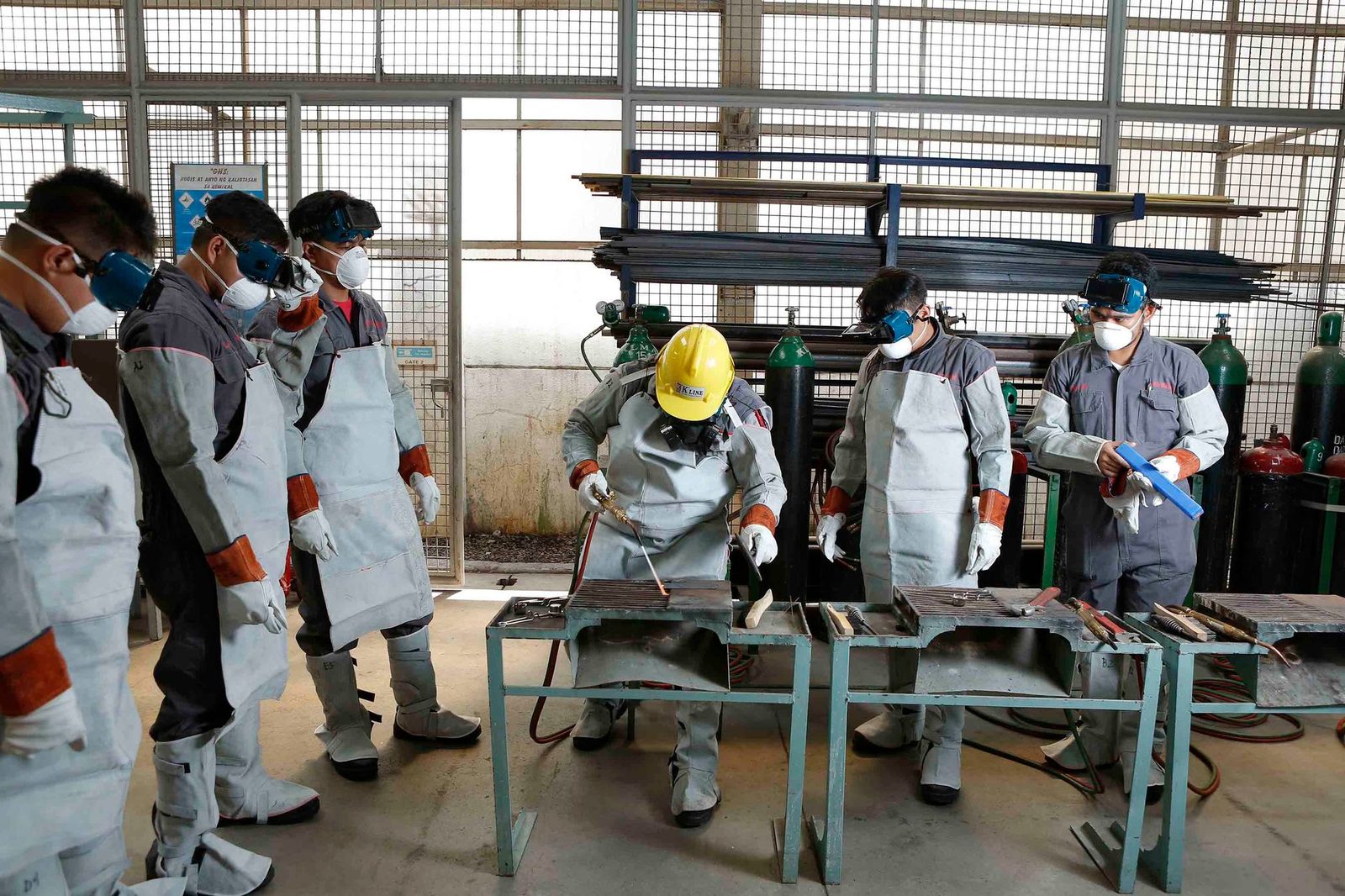
What adjustments should you ask for at work, at the CFA and in exams?
An adjustment is not a favour: article L. 5213-6 of the Labour Code requires the employer to take appropriate measures to enable a disabled worker to access a job, carry it out and receive training, unless the burden is disproportionate, which is assessed taking available funding into account.
At the company
Everything starts with the information and prevention appointment: a disabled worker is referred without delay to the occupational physician (article R. 4624-20), who can recommend adaptations to the workstation. These recommendations also trigger Agefiph funding.
Frequently recommended adjustments:
- Adapted computer setup: large screen, magnification or text-to-speech software, a vertical ergonomic mouse for musculoskeletal disorders.
- Environment: noise-cancelling headphones or a separate office, adapted seating, sit-stand workstation in the workshop.
- Organisation: shifted hours, extra breaks, part-time work, partial remote working where the role allows.
At the CFA: the disability officer's role
Since the law of 5 September 2018, every CFA must appoint an officer responsible for the inclusion of people with disabilities (article L. 6231-2). They build the adapted pathway, liaise with the employer and the awarding body, and can apply for Agefiph funding to adapt the training situation. Contact them as soon as you enrol.
In exams
For national education qualifications (CAP, bac pro, BTS…), the possible adjustments are: extra time of up to one third, technical or human assistance, keeping your marks for 5 years, spreading the exams over several sessions, or even adapting or waiving certain papers. The request must be made no later than the exam registration deadline, to a physician appointed by the CDAPH (simplified procedure if you already have a PAP or PPS). The authority gives its decision within 2 months. Missing the deadline means you risk sitting the session without adjustments: a week-at-a-glance diary with the deadlines noted from September prevents many unpleasant surprises.
Should you tell your employer about your disability, and when?
Legally, you have no obligation to declare your disability, neither at interview nor after being hired. A recruiter may not question you about your health: only the occupational physician is authorised to do so.
In practice, the question is strategic. For the company to receive the State's €6,000 or the Agefiph grant, and for you to count towards its employment obligation, it must have proof of your RQTH status. It all depends on your needs:
- No adjustment needed and no funding sought: nothing obliges you to mention it, and you can always do so later.
- Adjustment needed or funding at stake: raise the subject once the employer is interested, for example at the end of a second interview, presenting the solution and its funding rather than the problem. "I need an adapted screen, Agefiph funds it, and your company can receive up to €6,000 from the State" defuses the worry in one sentence.
That is the logic of our guide to acing your work-study interview: anticipate the objection. A book on preparing for job interviews also helps you fine-tune your answers.

Why is it in an employer's interest to hire an RQTH apprentice?
Beyond the grants, there is the employment obligation for disabled workers (OETH): every employer with at least 20 employees must have 6% of beneficiaries of the employment obligation in its workforce. An apprentice recognised as a disabled worker counts in the same way as an employee on a permanent or fixed-term contract. If it falls short of this rate, the company pays an annual contribution, unless it has an approved agreement.
Where can you find genuinely committed employers?
- Companies with a disability unit or an approved agreement: the subject is structured and budgeted for.
- Employers subject to the OETH that fall short of 6%: they have a direct interest in hiring.
- Specialist job fairs and job datings, where recruiters have already bought into the principle.
Cap emploi, working with France Travail, remains the reference operator: a dedicated adviser, introductions to employers and possible support during the contract. For the rest, follow the method in our guide to finding a work-study employer and browse the work-study vacancies.
Three costly mistakes
- Waiting for the MDPH decision before starting your search: up to four months lost, sometimes a whole intake.
- Discovering the disability officer at the end of the year: exam adjustments must be requested before the registration deadline.
- Negotiating a refused adjustment on your own: the occupational physician, the disability officer and Cap emploi are your allies, and the apprenticeship mediator at the chamber of trade or commerce steps in free of charge in case of deadlock.
What timeline should you follow for a September 2027 start?
| Period | What to do |
|---|---|
| October – December 2026 | File or renew RQTH status with the MDPH; shortlist courses and contact the CFA's disability officer |
| January – April 2027 | Target companies, specialist job fairs, Cap emploi appointments |
| April – July 2027 | Interviews, choice of contract length (up to 4 years), State and Agefiph or FIPHFP funding files |
| Signing | Information and prevention appointment, occupational physician's recommendations, ordering equipment |
| Exam registration | Request exam adjustments before the deadline |
The contracts that last are those where the subject was raised early, calmly and with solutions. The disability then becomes an organisational parameter, just like the work-study calendar, and all that remains is what matters: learning the trade.
Sources: French Labour Code (articles L. 6222-2, L. 6222-37, R. 6222-46 to R. 6222-51, L. 6231-2, L. 5213-6, R. 4624-20) on legifrance.gouv.fr; service-public.gouv.fr (RQTH, exam adjustments, apprentice hiring grants); monparcourshandicap.gouv.fr; agefiph.fr; fiphfp.fr.